|
|
Главная \ Методичні вказівки \ High-Context and Low-Context Cultures
High-Context and Low-Context Cultures« Назад
High-Context and Low-Context Cultures 14.10.2016 11:33
4. High-Context and Low-Context Cultures LECTURE 4.1 Characteristics of high-context cultures. Implicit communication, emphasizing nonverbal communication, collective initiative and decision making, relying on intuition or trust rather than facts and statistics, indirect style in writing and speaking, subordinating tasks to relationships, etc. 4.2 Characteristics of low-context cultures. Explicit (literal) communication, emphasizing verbal communication, separating job tasks from relationships, individual initiative and decision making, relying on facts and statistics direct style in writing and speaking, etc. 4.3 Guidelines for communication with representatives of high-context and low-context cultures. Chapter Objectives: After reading this chapter, you should be able to 1. Identify some cultures that are high context and some that are low context. 2. Compare and contrast high- and low-context cultures. 3. Compare value orientations among high- and low-context cultures. 4. Identify own position where you fit on the low and high context continuum. 5. Develop trainees’ skills of effective communication with the representatives of high- and low-context cultures. Learning outcomes: Upon completion of this chapter students will have critical awareness of:
Introduction In an increasingly connected and interdependent world effective communication not only becomes more important but also much more difficult. Ironically, it is often not dissimilar languages that cause the greatest problems but rather much more mundane and harder to detect cultural differences. One such difference is that of a high context (HC) culture versus a low context (LC) culture. The context gives additional information, which is necessary to encode the whole situation / background of given information. The picture demonstrates intercultural differences between high- and low-context cultures. Let’s analyze these differences according to the information given here. ☺(discussion of this table may encourage the trainees to involve into the problem giving them the opportunity to guess in general some features of two cultures)
(retrieved 10.05.2014 at http://my.ilstu.edu/~jrbaldw/372/Values.htm)
The next chart summarizes major differences between high- and low-context cultures. There are 9 criteria on which these cultures are defined. Here they are: ☺ (this table can be used as a hand-out to make the lecture easily understandable) SOCIAL FRAMEWORK: CHARACTERISTICS OF HIGH-AND LOW-CONTEXT CULTURES
Adopted from Edward Hall
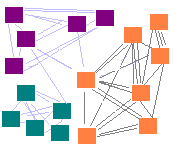
4.1 Characteristics of high-context cultures. Implicit communication, emphasizing nonverbal communication, collective initiative and decision making, relying on intuition or trust rather than facts and statistics, indirect style in writing and speaking, subordinating tasks to relationships, etc. Defining High-Context Culture Let’s have a closer look at high-context culture. High context refers to societies or groups where people have close connections over a long period of time. Many aspects of cultural behavior are not made explicit because most members know what to do and what to think from years of interaction with each other. Your family is probably an example of a high context environment. Anthropologist Edward T. Hall first discussed high-context culture in his 1976 book titled Beyond Culture. High-context cultures are those in which the rules of communication are primarily transmitted through the use of contextual elements (i.e., body language, a person's status, and tone of voice) and are not explicitly stated. This is in direct contrast to low-context cultures, in which information is communicated primarily through language and rules are explicitly spelled out. It is important to note that no culture is completely high-context or low-context, since all societies contain at least some parts that are both high and low. For example, while the United States is a low-context culture, family gatherings (which are common in American culture) tend to be high-context. In short we can characterized HC Culture as the culture with less verbally explicit communication, less written/formal information, more internalized understandings of what is communicated, with multiple cross-cutting ties and intersections with others, long term relationships, strong boundaries that means who is accepted as belonging vs who is considered an "outsider", knowledge is situational, relational. Decisions and activities focus around personal face-to-face relationships, often around a central person who has authority. (quoted from Culture at Work http://www.culture-at-work.com/highlow.html) (retrieved 12.09.2013 at http://www.culture-at-work.com/highlow.html) http://www.culture-at-work.com/CAWgraphics/highcontext.gif
☺ (in the context of this picture it is easy to explain the links among people and groups they belong to in HC cultures)
This picture demonstrates the relations among different groups of people in HC cultures.
Examples: Small religious congregations, a party with friends, family gatherings, expensive gourmet restaurants and neighborhood restaurants with a regular clientele, undergraduate on-campus friendships, regular pick-up games, hosting a friend in your home overnight. Members of high-context cultures usually have close relationships that last for an extended period of time. As a result of these years of interacting with one another, the members know what the rules are, how to think, and how to behave, so the rules do not have to be explicitly stated. This makes high-context cultures difficult to navigate for those who do not understand the culture's unwritten rules. Hall argues that the environmental, socio-relational, and perceptual contexts have an immense impact on communication. High-context cultures generally have restricted code systems. Users of a restricted code system rely more on the contextual elements of the communication setting for information than on the actual language code. In restricted code cultures, communication is not general across individuals in content, but is specific to particular people, places, and times. Within a high-context transaction, the interactant will look to the physical, socio-relational, and perceptual environment for information. Of particular importance is the social relationship between the interactants, especially their status. As Hall notes, twins who have grown up together can and do communicate more economically (HC) than two lawyers in a courtroom during a trial (LC), a mathematician programming a computer, two politicians drafting legislation, two administrators writing a regulation, or a child trying to explain to his mother why he got into a fight. Because interactants in a high-context culture know and understand each other and their appropriate role, words are not necessary to convey meaning. One acts according to one’s role. Words and sentences may be collapsed and shortened. In this sense, restricted codes are not unlike local dialects, vernacular, or even jargon used by a well-defined group. Users of restricted codes interpret messages based on their accumulation of shared experiences and expectations. Hall contends that persons communicating in high-context cultures understand that information from the physical, socio-relational, and perceptual environment already exists and need not be codified verbally. Therefore, high-context communication is fast, proficient, and gratifying. Unlike low-context communication, the burden of understanding in high-context communication rests with each interactant. The rules for communication are implicit, and communicators are expected to know and understand unspoken communication. high-context communication involves using and interpreting messages that are not explicit, minimizing the content of verbal messages, and being sensitive to the social roles of others. Although there are exceptions, many high-context cultures are collectivistic, including China, Japan, North and South Korea, Vietnam, and many Arab and African cultures. ☺ [In order to make the comparison of 2 cultures easier use ФОРМАТ2_SOCIAL FRAMEWORK.docx] And now let’s discuss peculiarities of "high-context" cultures. We'll examine nine aspects of the social framework of "high-context" cultures. A person from a high-context culture generally: Relies on implicit communication; Emphasizes nonverbal communication; Subordinates tasks to relationships; Emphasizes collective initiative and decision making; Views employer/employee relationship as humanistic; Relies on intuition or trust rather than facts and statistics; Prefers indirect style in writing and speaking; Favors indirect style in writing and speaking; Adheres to the spirit of the law.
People from high-context cultures have been taught from early childhood to look for implied meaning. They believe that what is implied takes precedence over what is said; they will recognize discrepancies between actual words and intended meaning. Example (Let us consider the following example): Although the phrase "to rubber stamp" means agreement in U.S. business, the expression would not translate correctly into Japanese. A Japanese report may indeed bear a stamp, but the placement and orientation of the stamp tells the receiver whether the report is acceptable as is, or whether it needs to be reworked and resubmitted. For a report to be approved, the rubber-stamped symbol must be perfectly aligned and not tilt to the right or left. Such subtle messages are readily noticed by those businesspeople who have been brought up in the high context Japanese culture.
Although nonverbal communication (body language, facial expressions, gestures and touching, conversational distance, eye contact, etc.) conveys meaning in every culture, people from high-context cultures rely more heavily on nonverbal communication than people from low-context cultures. The nonverbal communication provides the "context" for the conversation and, therefore, must be carefully observed for effective communication to take place.
In high-context cultures, children are imbued with reverence for family relationships and friendship, as illustrated by the Ukrainian proverb, 'Tell me who your friend is, and I'll tell you who you are." A friendship is a deep commitment developed over many years. Businesspeople brought up in high-context cultures carry over the importance of relationships to their transactions on the job. They may believe that a relative with less experience should be trusted over a stranger with more experience in a given job. They may award business contracts to those with whom they have forged relationships over many years rather than to the company that makes the best presentation or offers the best deal on paper.
A high-context culture values the collective as the important unit of society as exemplified by the Chinese proverb, "A single bamboo pole does not make a raft." Businesspeople from high-context cultures are taught to arrive at decisions that benefit the group. Advancing one's own agenda should never be the stimulus for action; rather, the group or team should initiate, develop, and carry out projects for the betterment of the company and of society. Self-aggrandizement is not only frowned on, it is also not allowed, and an individual risks losing his or her place in the group by "going it alone."
As you might suspect, the social framework of a society helps determine the relationship between employer and employee, so high-context cultures tend to view the employer/employee relationship in a humanistic rather than mechanistic way. Because these relationships are so important, high-context cultures see employees as "family" members that work for the good of the group and remain loyal to the company for many years. Job performances may vary widely without the threat of imminent dismissal. In addition, the employer will feel loyal to the employees and make decisions based on their welfare. Because trust is an important element in hiring decisions, family members would be preferred over strangers.
People from high-context cultures rely on trust or intuition to guide them in decision making. This trust must be established by forming a relationship with the potential business partner and will only be peripherally influenced by the reams of data that someone from a low-context culture might offer. Intuition or "gut feeling" is a large part of doing business in high-context cultures. Decisions won't be dictated by a plethora of written and spoken information but will be based on a sense of the context of the message. Example. ☺ (Here is an example of such feature. But: the example may be considered complicated to understand and may be omitted.) Translator Masato Abe tried to explain the importance of "reading between the lines" to his international colleagues. "In English, items obvious from the situation or context are commonly referred to using a pronoun. In Japanese, pronouns are less often used. Rather, known items are simply deleted from the sentence, resulting in sentences with no subject, transitive verbs with no direct object, indeed, sentences consisting of verbs alone." In such a sentence, the speaker or writer relies on the receiver's intuition and their relationship to understand the context of the message.
Given the emphasis on trust in high-context cultures, you may find that business writing and speaking need more space and time to establish rapport. For example, businesspeople from high-context cultures may begin a letter or email entirely indirectly. Only in the second paragraph will they bring up the main point of the business communication. Similarly, in business presentations, speakers will approach the subject indirectly, opening with attention to greetings and acknowledgments. In some, but not all, high-context cultures, it is considered rude to directly state the accomplishments, wealth, or expertise of the company. Instead, these attributes would be carefully intimated, and the focus would remain on mutual benefits. The relative worthiness of the company will be understated. For example, a company representing 28% of the Chinese computer market began their presentation by saying, "We have some small knowledge of this market."
People from high-context cultures will discuss issues from a holistic viewpoint with topics arising in random rather than linear order. Example. ☺ (In order to make the example clear we can demonstrate it on the blackboard.) A Puerto Rican manager, Juan Marin, was asked to give a brown-bag luncheon (неофіційна зустріч) talk at the mortgage company where he worked in Houston. The topic for the series of discussions was cross-cultural communication. As he spoke, Juan drew on the white board to illustrate the difference in the preferred reasoning style of his American co-workers. "You talk from point A to point B." Pedro drew a straight line connecting the two letters. "In my culture, it is different. We do it like this." At this point, Juan drew circles that overlapped eventually forming the pattern of a flower. His artwork drew lots of laughs and comments and was a revelation for those from low-context cultures who sometimes were impatient with Juan's tendency to talk "around" a subject. Most participants did not realize that preference for circular or indirect reasoning is culturally influenced.
Businesspeople who grow up in high-context cultures generally rely less on written contracts than their counterparts in low-context cultures. People in high-context cultures assume that it's impossible to anticipate every situation that may arise, and, therefore, would feel that agreements need to be revisited periodically in light of the new circumstances. Their attitude is not that laws were meant to be broken, but rather that laws should make sense given the surrounding events and changing circumstance (i.e., the "context" of the situation). Example. After "beating my head against the wall," a frustrated American vendor finally realized that she could save time and money by relying less on legal contracts when dealing with a family-owned agricultural supplier in Venezuela. "I now understand that our agreements are fluid, and I've adjusted to that reality." According to the American vendor, "I had to get to know them and vice-versa. Now, we can do business on a handshake and a letter of agreement. It's actually much easier and less expensive than hiring a lawyer to draw up the papers." *** High Context Communication is also common in many Western countries “The table sheds light on just how difficult it can be for a foreigner to understand what the British really mean when they’re speaking – especially for those take every word at face value. Phrases that prove the trickiest to decipher include ‘you must come for dinner’, which foreigners tend to take as a direct invitation, but is actually said out of politeness by many Britons and often does not result in an invite. The table also reveals that when a person from Britain begins a sentence “with the greatest respect …’, they actually mean ‘I think you are an idiot’.” (Alice Philipson in The Telegraph 02 Sep 2013)
4.2 Characteristics of low-context cultures. Explicit (literal) communication, emphasizing verbal communication, separating job tasks from relationships, individual initiative and decision making, relying on facts and statistics direct style in writing and speaking, etc. Low context refers to societies where people tend to have many connections but of shorter duration or for some specific reason. In these societies, cultural behavior and beliefs may need to be spelled out explicitly so that those coming into the cultural environment know how to behave. In short we can characterized LC culture as the culture with rule oriented, people play by external rules, more knowledge is codified, public, external, and accessible; sequencing, separation - of time, of space, of activities, of relationships, more interpersonal connections of shorter duration, knowledge is more often transferable, task-centered that means decisions and activities focus around what needs to be done, division of responsibilities. Decisions and activities focus around what needs to be done, division of responsibilities. (received 10.05.2014 at http://www.culture-at-work.com/highlow.html)
☺ (in the context of this picture it is easy to explain the links among people in LC cultures)
This picture demonstrates the relations people in LC cultures
Examples: large US airports, a chain supermarket, a cafeteria, a convenience store, sports where rules are clearly laid out, a motel. A low context culture is one in which things are fully (though concisely) spelled out. Things are made explicit, and there is considerable dependence on what is actually said or written. A high context culture is one in which the communicators assume a great deal of commonality of knowledge and views, so that less is spelled out explicitly and much more is implicit or communicated in indirect ways. In a low context culture, more responsibility is placed on the listener to keep up their knowledge base and remain plugged into informal networks. Low context cultures include Anglos, Germanics and Scandinavians. High context cultures include Japanese, Arabs and French. In contrast, a person from a low-context culture usually: Relies on explicit (literal) communication; Emphasizes verbal communication over nonverbal communication; Separates job tasks from relationships; Emphasizes individual initiative and decision making; Views employer/employee relationship as mechanistic; Relies on facts, statistics, and other details as supporting evidence; Uses direct style in writing and speaking; Prefers linear reasoning; Adheres to the letter of the law.
Example: Susan Shofield was district manager for a national wholesale shoe company. After rising quickly through the ranks to become district manager of the Southeast U.S., she was surprised that the company wanted to transfer her to the Midwest. Susan, who had lived all her life in the South, knew that the move would be difficult and expressed her concerns to a customer who owned a chain of children's shoe stores in Alabama. Example: Tom Womeldorf had lived in Springfield, Illinois, most of his life and talked about the adjustment he and his family had to make when they set up shop in the South. "At first, I was too direct, but I learned by listening to my customers how they expected me to communicate. You're a good listener, so it won't take you long to figure out Midwesterners. The people up there say what they mean and mean what they say." ☺ (In the end of the last story-example it is possible (if you think it is necessary) to make a general short conclusion such as “Your success in business and good relationships with people depend on your knowledge of customs and traditions of the place you work or live in”, etc.)
The phrase that Susan Shofield heard in the above example ("Say what you mean and mean what you say") is often repeated to children from low-context cultures as they are growing up. Parents place far less emphasis on communicating indirectly or nonverbally and ask their children to "speak up." By the time they enter business, people from low-context cultures have learned to rely on words to convey exactly what they mean. This preference for verbal communication carries over to the workplace where businesspeople are expected to "spell out" what they mean as clearly and directly as possible.
☺(Before the discussion of this feature of LC culture ask the trainees to draw three circles on a piece of paper. One circle will represent their family relationships, the second will represent job relationships, and the third will represent church and community relationships. The students should draw the three circles to show the extent to which the three groups of relationships overlapped. Give them time to do it and let them share their points of view. )
People from low-context cultures usually prefer to keep their job tasks separated from their relationships. Indeed, relationships are seen as outside the task rather than an integral part of it. Even if a key person on a project leaves the company, another person can easily take his or her place since the business transactions are considered to be between companies and not based on relationships between people. Example: In a training session on cross-cultural business communication at a multinational corporation in Los Angeles, the participants were asked to draw three circles on a piece of paper. One circle represented their family relationships, the second represented job relationships, and the third represented church and community relationships. Participants were asked to draw the three circles to show the extent to which the three groups of relationships overlapped. Out of 20 participants, 12 drew three distinct circles with no overlap. All 12 were from low-context cultures. The participants whose circles overlapped were all from high-context cultures. Neither group had considered that the way they viewed the separation of or the combining of task and relationship was part of their culture.
☺(Ask trainees what is preferable for them – to be members of a team and gain a group award or distinguish themselves as individuals and gain an individual award. Let them express their points of view and reasons.)
Those whose cultures are lower on the context continuum tend to value individual initiative, decision making, and achievement. As the American proverb states, "Look out for number one." Even when they work in groups, individuals from low-context cultures try to think of ways to distinguish themselves as individuals. In business, a group award is valuable and desired, but an individual award is usually more highly prized. The individual is expected to define and solve problems with little supervision. Example. A professional coach was working with a mid-level manager at a manufacturing plant in Chicago. The coach was from the Euro-American culture, and the manager was West African. One of the "needs" identified by the professional coach was for the manager to establish his individual accomplishments. "Put your name on all your reports, so they'll know that you took the lead on these projects," advised the coach. The West African manager was very troubled by the instructions. It didn't feel "right" to take credit for work done by his team to which he felt much loyalty. The thinking of the professional coach reflected his low-context culture.
A commercial for a U.S. financial company shows a young man talking to his father about a job change. The young man laments the loss of friendships at his old job. He continues by talking to his father about the opportunities in the new job and the ease with which he has rolled over his retirement plan. In response, his father offers support for his decision to leave the old job for the better opportunity even if it means leaving friends at work. He says, "The new job's great. It's going to be OK." ☺ (The example may be omitted. Let the trainees talk about this problem. Let them think of themselves as family members at work or replaceable parts.)
Because of their low-context orientation, the Jewish culture values precision when it comes to legal rulings. To prepare for a spaceflight mission, Israeli astronaut Ilan Ramon did more than learn about the experiments he would conduct as a payload specialist on the U.S. space shuttle Columbia. Because he planned to observe the Jewish Sabbath in space, he asked for a ruling from Jewish leaders to determine exactly when he should begin and end his observance of Shabbat, the weekly Jewish Sabbath, which lasts from sundown Fridays to sundown Saturdays. A group of respected rabbis debated and discussed the question. Before the flight, Colonel Ramon received a ruling that he should observe the Sabbath on Eastern Daylight Time because that was the shuttle's point of departure. In the low-context Jewish culture where adherence to the law is revered, such a decision would never be left to chance.
* * * Now let us take a look how members of high and low contextual cultures see themselves and their opposites:
For an example how a low context culture interacts with a high context culture as the Chinese, please visit GlobThink: http://globthink.com/2009/06/24/indirect-communication-and-indirect-leadership-in-asia/ Unfortunately this link is broken / not existing anymore (reviewed 12.12.2012) Conclusion The implications are obvious. Interactions between high and low context peoples can be problematic. For example: Japanese can find Westerners to be offensively blunt. Westerners can find Japanese to be secretive, devious and bafflingly unforthcoming with information. French can feel that Germans insult their intelligence by explaining the obvious, while Germans can feel that French managers provide no direction. High context cultures are vulnerable to communication breakdowns when they assume more shared understanding than there really is. They are strongly inclined to indirect methods of communication. This is especially true in an age of diversity. Low context cultures, on the other hand, are not known for their ability to tolerate or understand diversity, and tend to be more insular. The explicitness with which they communicate can often cause offence and resentment. According to Hall, in a low-context transaction, the verbal code is the primary source of information. Low-context cultures generally rely on elaborated codes. Unlike users of restricted codes, users of elaborated codes rely extensively on the verbal code system for creating and interpreting meaning. Information to be shared with others is coded in the verbal message. Although persons in low-context transactions recognize the nonverbal environment, they tend to focus more on the verbal context. Moreover, the rules and expectations are explicitly explained. Users of elaborated codes are dependent upon words to convey meaning and may become uncomfortable with silence. In low-context transactions, the communicants feel a need to speak. People using low-context communication are expected to communicate in ways that are consistent with their feelings. Hence, low-context communication typically involves transmitting direct, explicit messages. Although there are exceptions, many low-context cultures are individualistic, including Switzerland, Germany, Scandinavia, the United States, France, and the United Kingdom.
4.3 GUIDELINES: HIGH OR LOW CONTEXT Entering High and Low Context Situations High contexts can be difficult to enter if you are an outsider (because you don't carry the context information internally, and because you can't instantly create close relationships). Low contexts are relatively easy to enter if you are an outsider (because the environment contains much of the information you need to participate, and because can you form relationships fairly soon, and because the important thing is accomplishing a task rather than feeling your way into a relationship). Remember that every culture and every situation has its high and low aspects. Often one situation will contain an inner high context core and an outer low context ring for those who are less involved. For instance, a PTA (Parent-Teacher Association) is usually a low context situation: any parent can join, the dates of the meetings, who is president, what will be discussed, etc. are all explicitly available information, and it is usually fairly clear how to participate in the meetings. However, if this is a small town, perhaps the people who run the PTA all know each other very well and have many overlapping interests. They may "agree" on what should be discussed or what should happen without ever really talking about it, they have unconscious, unexpressed values that influence their decisions. Other parents from outside may not understand how decisions are actually being made. So the PTA is still low context, but it has a high context subgroup that is in turn part of a high context small town society. NOTE: When you enter a high context situation, it doesn't immediately become a low context culture just because you came in the door! It is still a high context culture and you are just (alas), ignorant. Also, even low context cultures can be difficult to learn: religious dietary laws, medical training, written language all take years to understand. The point is that that information has been made conscious, systematic, and available to those who have the resources to learn it. Once you have thought about your customers and colleagues in terms of high or low context, you can find a middle ground for effective business communication. For example, if you are from a low-context culture dealing with someone from a high-context culture, you will flex your communication style to obtain the results you desire from your business communication. Follow the suggestions below as you prepare to write or speak. When conducting business in a high-context culture:
When conducting business in a low-context culture:
КомментарииКомментариев пока нет Пожалуйста, авторизуйтесь, чтобы оставить комментарий. |